
India at a Development Crossroads
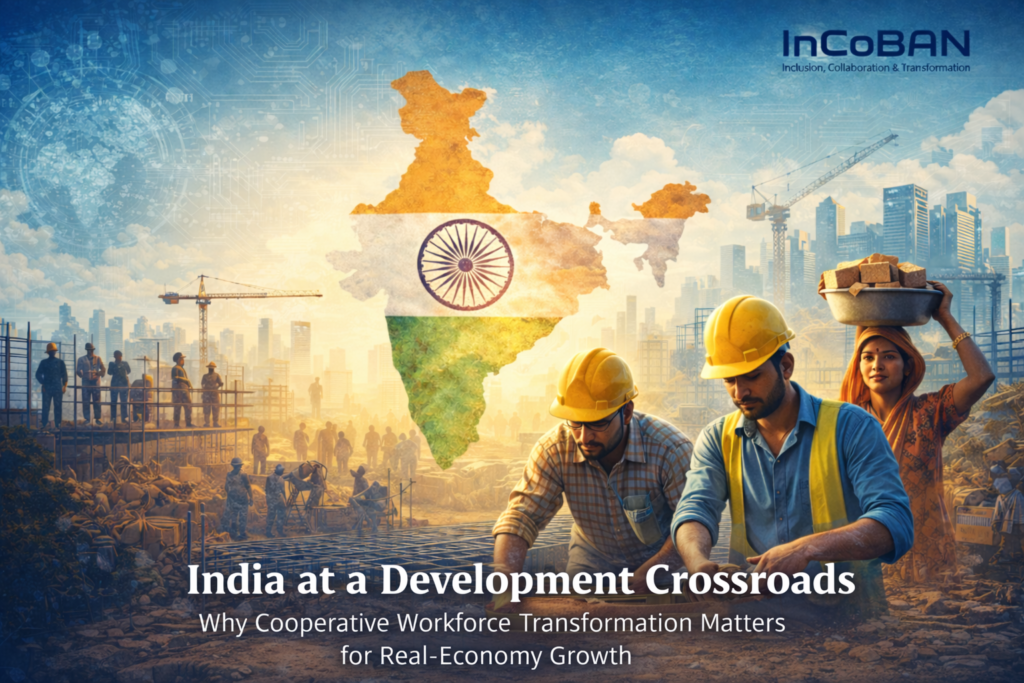
A Shift in the National Development Narrative
India today stands at a decisive moment in its development trajectory. As the Business line article rightly highlighted, the country is beginning to recognize the potential of a cooperative development model one that strengthens institutions, empowers communities, and unlocks the latent potential of millions whose labor forms the invisible scaffolding of our growth story.
Yet the national conversation continues to be dominated by a valuation-driven startup ecosystem, where ‘value add’ is often mistaken for ‘valuation’, and where technology-led scale is celebrated far more than real-economy transformation.
The Structural Bias Towards Valuation
This gap is not accidental; it is structural. Digital-first ventures have found fertile ground in India—low friction, rapid adoption, and venture capital willing to chase exponential multiples. However, initiatives that create value through physical clusters, workforce organisation, and productivity enhancement in traditional sectors rarely receive similar enthusiasm.
Such innovations are often dismissed as ‘low-scale’, ‘low-tech’, or ‘not VC-worthy’, even though they hold the key to India’s long-term economic resilience. The construction industry one of India’s largest employers, with over 8 crore livelihoods dependent on it—perfectly illustrates this blind spot.
The Construction Workforce Challenge
When InCoBAN first articulated the idea of a Multi-State Cooperative (MS COOP) to organize the construction workforce, the startup ecosystem politely asked: ‘Where is the value add?’ The question, however, referred only to valuation not to the transformation of an entire economic layer.
Industry and government, in contrast, immediately recognized the structural significance of the model. They confront the consequences of informality every day project delays, productivity losses, safety risks, skill shortages, cost overruns, and escalating migration unpredictability.
Industry Hesitation and the Global Paradox
There remains hesitation particularly within sections of the contracting and construction community. Workforce organization is sometimes viewed with suspicion, with concerns around compliance, cost, or operational flexibility.
This hesitation is paradoxical. The same companies benchmark the United States, Europe, and Australia for construction technology, digital adoption, safety systems, and project management maturity. Yet they seldom examine how those ecosystems addressed workforce stability not through fragmentation, but through collective social enterprises, labor cooperatives, industry associations, and collaborative clusters.
Technology Cannot Replace Institutional Foundations
India must now confront a simple truth: technology alone cannot build a nation. Infrastructure does not rise from code; it rises from people. A digitally enabled but physically disorganized workforce cannot sustain a modern economy.
Real-economy transformation requires institutional architecture frameworks that organize labor, improve productivity, reduce informality, and strengthen sectoral resilience.
The Case for Cooperative, Cluster-Led Workforce Transformation
India requires a cooperative, cluster-led approach to workforce mainstreaming one that integrates institutional design, productivity improvement, workforce dignity, delivery predictability, and sector-wide collaboration.
InCoBAN In Cooperation to Build Assets for the Nation has spent three years building a structured framework for precisely this purpose. The framework is ready for implementation.
Moving from Debate to Deployment
The question before the sector is no longer whether workforce reform is required. It is whether industry stakeholders are prepared to move beyond valuation-led narratives and engage with institutional transformation.
National value must complement financial valuation. India’s infrastructure ambitions demand nothing less.
For engagement, reach us at: enquiry@incoban.org



Leave a comment